




"There are these two young fish swimming along and they happen to meet an older fish swimming the other way, who nods at them and says, 'Morning, boys. How's the water?' And the two young fish swim on for a bit, and then eventually one of them looks over at the other and goes, 'What the hell is water?'" - David Foster Wallace
___
Topics in this post: Oil, Energy, Chemistry
___
I begin with this quote, though oil to humans is not quite as obvious a connection. We don’t use oil to breathe. But I do think it’s a great mindset. I would say most people think that oil is mostly about gasoline and diesel, but that is selling it short. When I really look into what oil is, it’s stored energy from the sun. I’ve heard it called dinosaur juice, but it actually comes from dead plankton and algae that captured solar energy from the sun. Over very long periods of time, it was compressed and heated to eventually become a concentrated liquid with an incredible level of contained energy as a result. Ancient sunlight in liquid form that happens to be highly portable. Oil's superpower is centered around the measurements of energy density, volume, and weight, combined with being a liquid at temperatures similar to human activity.
If you’re a history buff, know that the rise of oil wasn’t planned. Discoveries of its usefulness happened in cascading ways; each new use led to another. Here are a few milestones that stick out:
- Drake’s well (1859) was the first deliberately drilled well to prove a case for industrial-scale usage that happened to line up with kerosene being refined for lamps. Before this, whale oil was used, but the world was running out due to overhunting. An interesting point at this time was that gasoline was considered a useless byproduct that was often just dumped into rivers. I find this little point crazy from an environmental standpoint.
- Spindletop (1901): Prior to this Texas boom, oil was primarily used for lighting and as a lubricant. Because of the quantity of oil discovered, burning petroleum as a fuel for mass consumption suddenly became economically feasible.
- Ford Model T (1908), generally regarded as the first mass-affordable automobile, made travel affordable to the masses. More cars meant more need for oil.

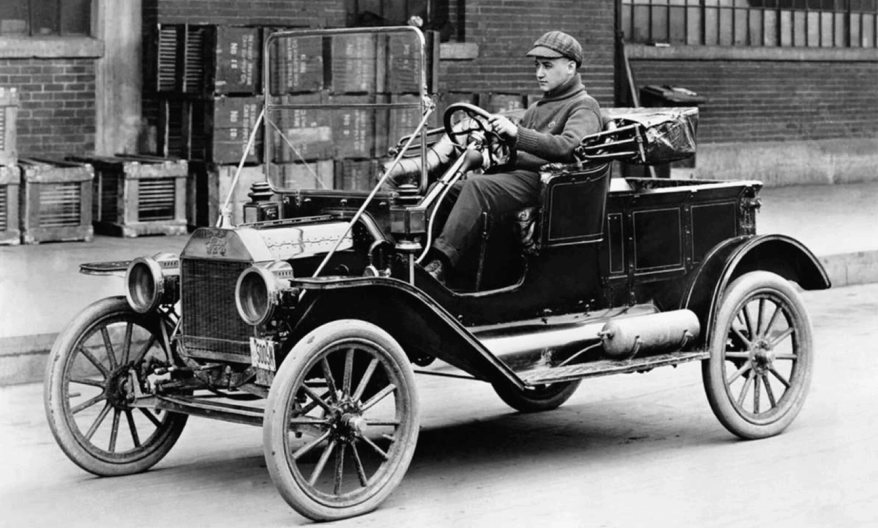
So, the need to solve a problem leads to innovations.
Chemistry isn’t my strong point, but here’s what’s happening at the molecular level. Oil is a hydrocarbon, a molecule made of hydrogen and carbon, that’s it. Carbon is unusual in that it bonds easily with other carbon atoms, which lets you string long chains together and attach hydrogen to each one. For example, one carbon atom with four hydrogen atoms attached creates a methane molecule… aka, natural gas. Five to twelve carbons make up gasoline grades. Twelve to twenty is jet fuel and diesel. (I want to note that numbers can vary slightly as petroleum refining isn't an exact science of counting single atoms; it’s a process of fractional distillation.) Past twenty, you reach the heavy fractions: motor oil, waxes, and eventually asphalt — chains so long they stay solid at room temperature. Same two elements, different chain lengths, completely different materials. I wish I had cared more about chemistry when I was younger, but I digress.
As you can see in the diagram below, as the carbon chains get longer, the physical state transitions from a light gas to a heavy solid. Note that numbers can overlap due to mixtures and where the crude is sourced from. It gets complicated ;-)

Every carbon-hydrogen bond in those chains stores energy. Combustion breaks the bonds, carbon and hydrogen grab oxygen from the air, and what comes out is water vapor, carbon dioxide, and a lot of heat…more heat per kilogram than almost anything else in nature.
One of the refined products to come from oil is gasoline. One gallon of gasoline holds roughly 33kWh of energy. For a frame of reference, a Tesla Model 3 electric car contains a lithium battery capacity of roughly 75 kWh… so about 2.3 gallons of gasoline (approximately 6.26 kg) contains the same amount of energy as a massive 480 kg Tesla battery pack.
Side note: that may get you to think about efficiency. The average gasoline car in 2026 achieves about 25 to 29 MPG. If you're wondering, electric cars are much more efficient with the energy they use. The energy reaching the wheels in a gas car is only about ~20–30%, due mostly to losses via heat vs around 75-85% in an electric car (the electric motor can also act as a generator during deceleration or going downhill).
But the kicker is that energy density matters more than efficiency, in most current use cases that involve economic activity, i.e. shipping logistics.
Here are some material energy density comparisons to think about. First, a constant: A typical gasoline car getting 30mpg that needs to go 400miles. This requires approximately 478 kWh of gasoline chemical energy that yields about 119 kWh of work to the wheels… figuring ~25% efficiency from the car. Nerd alert ;-)
Here’s how diesel, hydrogen, coal, wood, and a lithium-ion battery pack compare against gasoline for the same 400-mile trip:
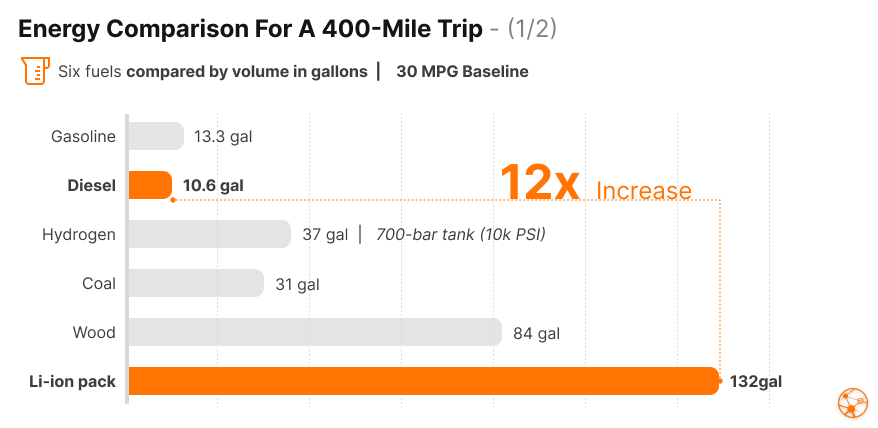

Here is what sticks out to me. First, Diesel is a silent winner (not literally ;-) A 32 kg / 40 L fill beats gasoline, and a diesel engine has a more efficient energy cycle. This is why logistical transportation systems like marine shipping, trains, long-haul trucks, and heavy equipment all use diesel. Hydrogen fuel is really about volume and high pressures. Once you think about the container needed, the advantages go away. Maybe future technology will solve this. The wood and coal comparison is just for kicks. It doesn’t take much to understand why we don’t use either in modern transportation. Just think back to how big a steam train was that ran on coal being fed into the burner. A battery is where it gets really interesting, at least with current technology limits. Weight is the limiting factor. You can’t just scale up to solve the problem. For example, in trucking, there is a weight limit that impacts payloads. Anything aviation-related is always affected by weight. (I used to work in aircraft maintenance, weight distribution, and totals were everywhere.) So, the fuel is one part, but don’t forget the storage part of the equation.
Side note: Electric is a good substitute for short-distance trucking, and notice that modern trains in North America use a combination of electric and diesel (Europe is different due to differing priorities). I personally think electric is a smart way to go for urban transportation. But I do love the sound of an internal combustion engine and how revs make me feel.
Energy is the most common thing people think about when it comes to oil. But consider this: oil is not a one-trick pony. Here are some other special properties of oil, besides being liquid at ambient temperatures:
- Stable for long periods (unlike batteries, which self-discharge)
- Transportable by pipeline, ship, truck, or rail without energy loss (this is a huge factor for long distances)
- Refinable into a spectrum of products from one input
- Feedstock-capable — it’s not just fuel, it’s raw material for matter itself (plastics, fertilizers, pharmaceuticals)
Those last two bullets are something to remember because it goes beyond just a source of energy… which solar, geothermal, nuclear, and wind do not provide. I will touch on this in a later post.
Oil is really a marvel product that was and still is a critical building block of our modern civilization for the foreseeable future. Oil’s combination of energy density, portability, and stability is the framework of nearly every system you’ll interact with on a daily basis. My next post answers a different question: how much work does a single barrel actually do… and what would it take to replace that work with human hands?”